
Chemical biology for challenging protein targets
We develop small molecules to understand and modulate protein function, focusing on biologically important targets that are novel, poorly characterised or difficult to drug. Our research integrates synthetic and medicinal chemistry with quantitative biophysics, structural biology and computational approaches.
EXPLORE OUR RESEARCH
JOIN OUR LAB

Latest news:
New tool compound AG3 now published
in the Journal of Enzyme Inhibition and
Medicinal Chemistry. Well done everyone!


May 2026, Baud Lab at the International p53 Workshop. Members of the group joined the international p53 community in Toronto to present our latest work on mutant p53 pharmacological chaperones.


December 2025: Tom is at Pacifichem to presents his PhD work on the development and application of computational approaches to inform the design of new ligands targeting mutant p53. Great stuff!


December 2025: Baud/Williams groups Christmas Dinner 2025! Great evening in great company to celebrate another successful year.

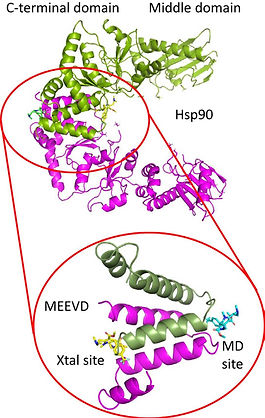
December 2025: Beautiful work led by our collaborators from the University of Sussex on the mode of action of the dihydropyridine derivative LA1011, a first of its kind confirmed ligand of HSP90, with potential implications for future drug development and medical research in AD. The dihydropyridine LA1011 modulates multiple Hsp90—co-chaperone interactions relevant to Alzheimer’s disease, now published in Cell Stress and Chaperones.

November 2025: Our new collaborative paper with the Bulatov group in Kazan on p53-Y220C reactivation, Cellular activity upregulation of the thermolabile p53 cancer mutant Y220C by small molecule indazole derivatives, has been published in Cell Death Discovery. Low molecular weight, JC heterocyclic compounds induce mutant-to-WT conformational shift of cellular p53-Y220C, reminiscent of past reports from colleagues from the Fersht and Spencer labs (NAR 2013, 12,1,6034-44). Another step forward, some answers, and more questions, in our quest of improved pharmacological chaperones targeting mutated p53 variants.


